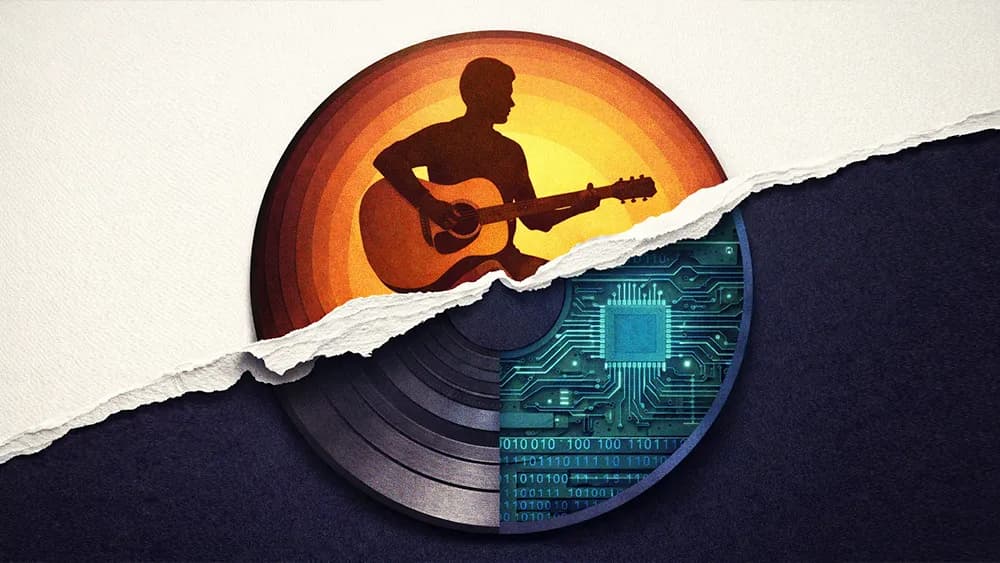

With AI “bands” like Velvet Sundown garnering success on major streaming platforms, the music industry is faced with an almost existential challenge. The growth of AI-generated music is accelerating, and many listeners cannot tell the origin of what they’re listening to. The industry's silence on the issue has ignited a debate about what consumers deserve to know and what creators are owed, creating legal quandaries around transparency.
Jeff Perkins, CEO of music licensing provider Soundstripe, has a uniquely informed perspective on the AI music debate. With a track record that includes growing the user base of ParkMobile from 8 million to over 50 million as its CMO and later CEO, Perkins has a deep understanding of technology platforms and media. He says that transparency and clear labeling standards aren't optional, they're a requirement necessary for upholding the very music business itself.
“Listeners have a right to know if a song was created by AI. Transparency isn’t optional. It’s essential if people are going to trust what they’re hearing,” says Perkins. For Perkins, the debate hinges on a clear line between AI as a creative tool and AI as an outright replacement for the artist. That latter category, he believes, is fundamentally different and requires clear disclosure.
- Tool or takeover: "For me, creation means actually playing an instrument, writing the song, and conceptualizing its sound," says Perkins. "Pure prompt-based generation, which doesn't involve that process, is AI-created music and needs guardrails. But when a human leverages AI tools to flesh out a song they wrote, that's real artistry. The line is clear: there must be a human creator you can point to who actually wrote the song."
- The human connection: Perkins isn't alone in feeling this way. A growing tenet among music industry analysts and creators, as opposition to purely AI-generated music grows, is that the entire commercial ecosystem is built around artists- a value chain of concerts, merchandise, and storytelling that an algorithm can't replicate. While tools enabling AI-assisted creativity can be beneficial, the rise of fully generated music is challenging the very definition of artistry. "You can't go see an AI artist perform in concert. People connect with popular music because a human artist is trying to say something. What is AI trying to say? It isn't trying to say anything. It's just gathering data on what human artists wanted to say and representing that intent in a generic way."
- Credit where credit is due: He points out that because the generative models powering this new wave are trained on the work of human artists, often without consent, the practice borders on "almost fraud," leading to major copyright infringement lawsuits. The industry's attempts to navigate this with piecemeal compensation structures have fallen short of solving the core problem of fairness. "A basic fairness issue is at stake: The AI models have been trained on music by real artists, and those artists haven't been compensated. If a fake band like Velvet Sundown was trained on the style of Mumford and Sons or Noah Kahan, what's the cut for those bands? That compensation model simply has not been established."
The imbalance creates downstream consequences. Some platforms have begun flagging songs created with AI to combat the skewed market forces caused by bots, while others are exploring platform solutions like AI detection. Perkins’s proposed solution is a clear data trail.
- Follow the money: "These AI platforms were built by genius-level people," Perkins says. "They have the capability to disclose what songs their models are trained on. A data trail should be required for every song, showing exactly what it was trained on, so the original artists can be compensated. You can't tell me they can't figure out what percentage of what song they trained on. It should not be the most complicated thing in the world to figure this out."
- Visibility into creation: But the problem isn't just about creative fairness. It's about cold, hard commercial risk. Perkins points out that the lack of a transparent framework creates a serious level of risk for businesses. "I would say stay away from anything AI for commercial use. The AI companies are putting the legal onus on the brands and not taking responsibility themselves. This means if a lawsuit arises, the brand takes the financial hit because they are not indemnified from a high-dollar claim. Unless you have full visibility into how a song was created and a guarantee that the AI platform will fully indemnify you, there is simply too much risk."
Perkins questions the fundamental purpose of mass AI music generation by contrasting it with AI video, which solves a high-cost production problem for creators. Music, he notes, already has millions of affordable, licensable songs available. In exchange for chasing AI hype, we may inadvertently give up the very core of what makes the music business tick. To drive the point home, he shares the story of an artist who, during a difficult time, was inspired by a t-shirt she found at TJ Maxx that read "You Can Do Hard Things." That moment led her to write a song titled Life is Tough (But So Are You), a track born from a real, lived story. It's a powerful reminder that the future of music depends on platforms that protect human creativity and keep human creators at the center of the ecosystem. "That's something AI will never give you: the origin story behind the art."